House Edge, Plinko Game
Clear answers on house edge for plinko game, checked against the live platform and updated when it changes.
What is House Edge?
The house edge is the built-in mathematical advantage a Plinko game platform holds on every ball drop. Expressed as a percentage of your total wager, it represents what the platform retains as profit averaged across thousands of rounds. If a Plinko game carries a 1% house edge, the platform expects to keep ₹1 for every ₹100 wagered over a large sample. On plinkogameindia.org, the house edge is embedded directly into the payout multipliers assigned to each bucket at the bottom of the board.
The board's geometry, row count, peg density, and pyramid width, determines the true probability of a ball landing in any slot. Operators set multipliers slightly below those true odds. That gap between a mathematically fair payout and the displayed multiplier is exactly where the house edge lives. Typical Plinko house edges range from 0.5% on low-risk settings to around 3% on high-risk settings, making risk mode the single biggest lever you control.

House Edge Step by Step
A 16-row board creates 17 possible landing buckets. Each bucket carries a real probability derived from Pascal's triangle, the two outer buckets sit near 0.0015% each, while the centre bucket approaches 20%. The platform assigns a multiplier to every bucket. Multiply each multiplier by its probability, sum all 17 results, and you get the expected return per ₹1 wagered. Anything below ₹1 is the house edge expressed as a decimal.
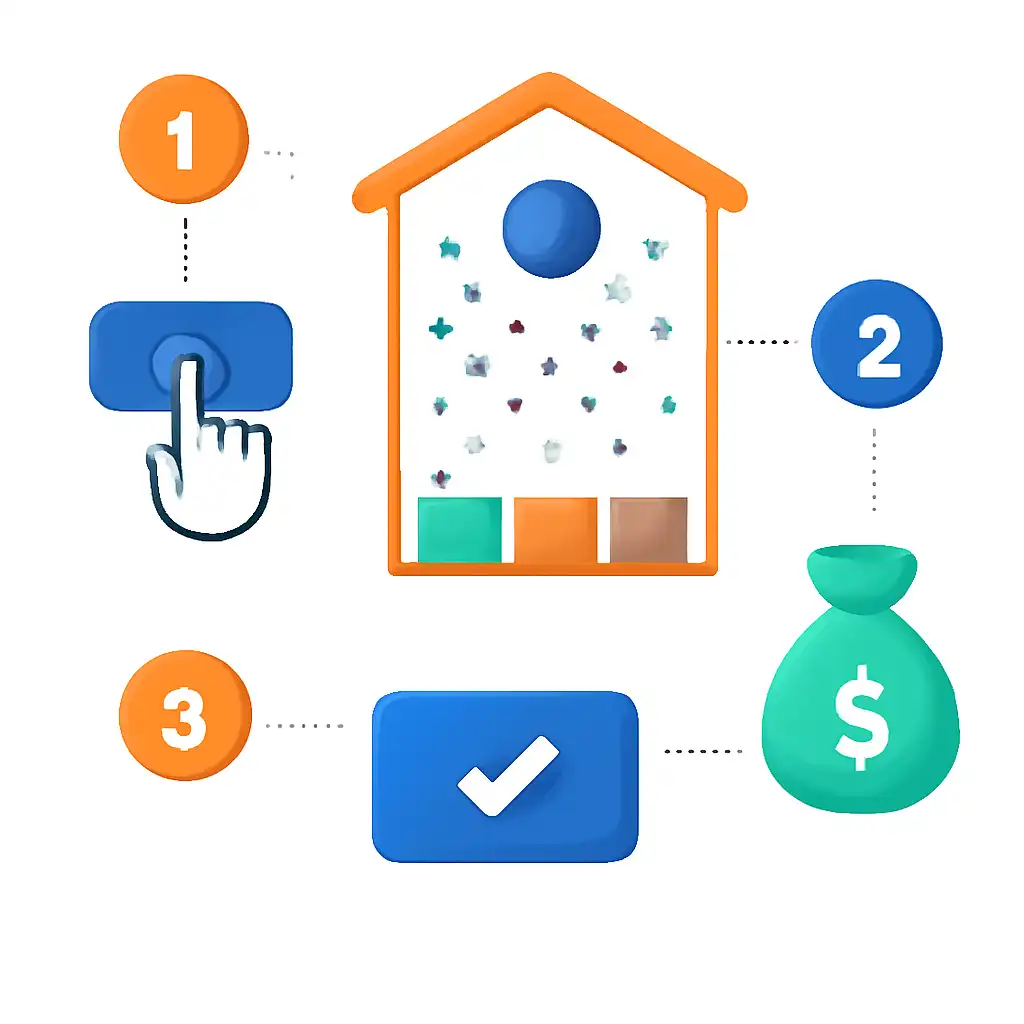
Run this three-step check before any session. Step 1: Identify your risk mode, low-risk keeps the multiplier spread flat and edge near 0.5% to 1%. Step 2: Estimate your session wager total, 100 drops at ₹10 stake equals ₹1,000 wagered; at 1% edge your expected cost is ₹10. Step 3: Treat that cost as the price of entertainment and stay within it. Switching to high-risk mode can triple the edge percentage without changing your per-drop stake, so mode selection matters more than stake size alone.
House Edge for New Players
Start on low-risk mode with an 8-row or 12-row board. Fewer rows produce a narrower multiplier spread and a lower effective edge, so your starting bankroll erodes slowly while you learn ball behaviour. New players who jump straight to high-risk 16-row mode chasing large outer multipliers face an edge that can be 2 to 3× higher, draining a ₹200 deposit in far fewer drops than expected.
Budget for at least 100 drops at your chosen stake before you begin. This sample size is large enough to experience realistic variance without exhausting your deposit in minutes. As you grow comfortable with drop patterns and payout rhythms, move to medium-risk, multipliers widen but edge stays controlled compared to high-risk. Never increase rows and risk mode at the same session; change one variable at a time so you can clearly see its effect on your balance.