How a Round Works, Plinko Game
A practical guide to how a round works for plinko game: the steps, the limits and the common mistakes.
What is How a Round Works?
A single round in a plinko game is one complete cycle, from the moment you release a disc at the top of the pegboard to the instant it settles into a prize bucket at the bottom. The board holds a grid of evenly spaced pegs arranged across 12 to 16 rows. At each peg the disc deflects left or right, producing a path that is impossible to predict in full, even though the physics behind every bounce is entirely real.
Most digital versions available to Indian players display boards with 9 to 17 prize buckets at the base. Outer buckets carry the highest multipliers, sometimes 100× to 1000× your stake, while centre buckets pay out smaller but far more frequent amounts. Each round is fully independent: the result of your previous drop has zero influence on the current one, enforced through certified random number generation.

How a Round Works, Common Questions
Can I choose where the disc lands? No. You choose your drop column at the top of the board, which shifts the probability distribution slightly toward one side, but peg collisions introduce enough variance that no column guarantees a specific bucket. Dropping from the far-left column increases your statistical exposure to left-side high-multiplier buckets, but it is not a lock.
How long does one round take? The disc completes its descent in 3 to 6 seconds of animation on most platforms. Turbo mode, available on several plinko sites accepting PhonePe and GPay, compresses this to under 1 second. How is the payout calculated? Stake × bucket multiplier. A ₹50 stake landing in a 10× bucket returns ₹500, credited instantly before you set up your next drop.
How a Round Works, Safety and Timing
Every round result on a reputable plinko platform is generated before the disc animation begins. The RNG seeds the outcome the moment you confirm your drop, not during the fall, meaning the visual descent is a replay, not a live calculation. Provably fair platforms publish a hash of the seed before you drop and reveal the full seed after, so you can independently verify the bucket outcome was pre-determined honestly.
Fast-mode rounds can run 40 to 60 cycles per minute, compressing your session bankroll quickly. Setting a per-session round limit in the responsible gambling menu gives you a hard stop before a losing streak escalates. Treat each round as a discrete financial decision, not part of a continuous streak.
How a Round Works, Step by Step
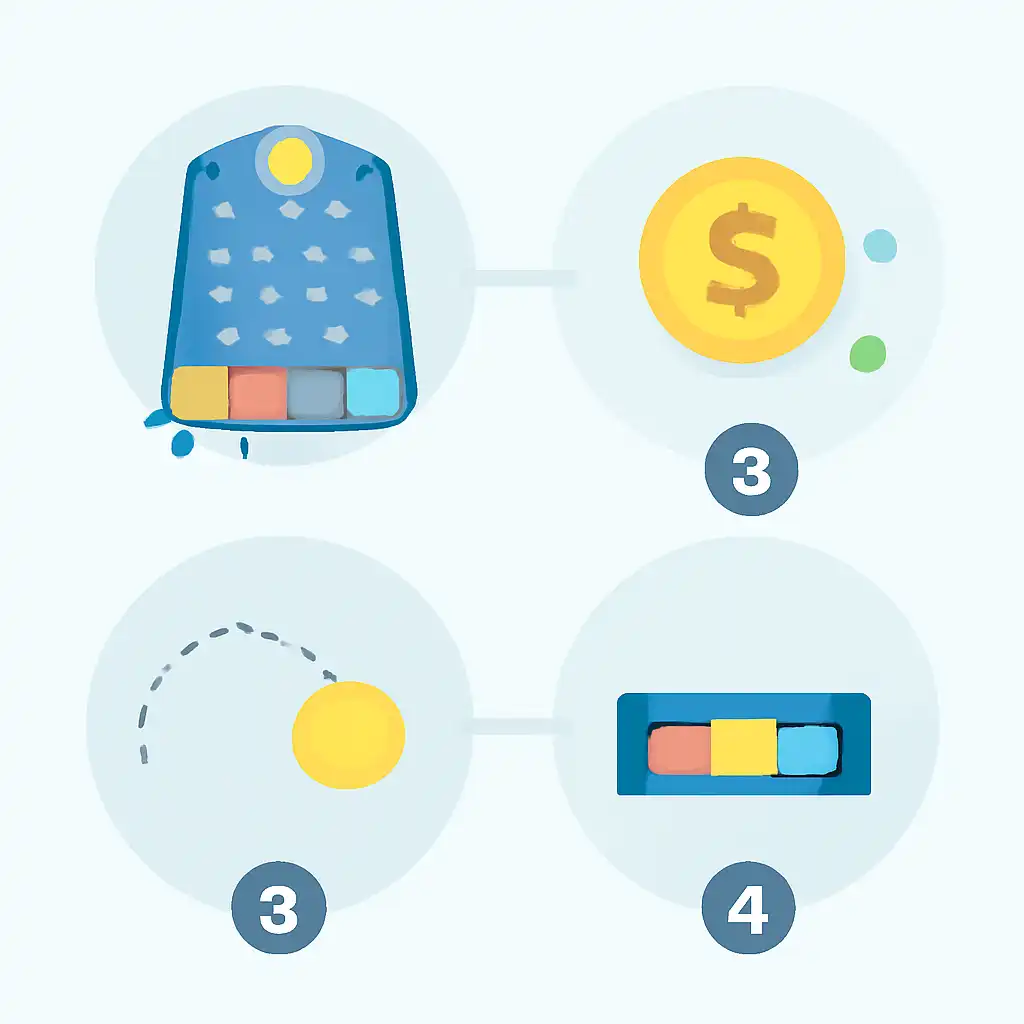
Step 1, Set your stake. Choose your bet amount using the +/− controls. Most platforms accept stakes from ₹10 up to ₹10,000 per drop. Step 2, Select your risk level. Low, medium, and high risk settings adjust the multiplier spread: low risk keeps payouts tight and frequent; high risk widens the gap between the top prizes and the most common small returns.

Step 3, Pick your drop column and release. Click or tap to drop the disc. The RNG result is locked at this exact moment. Step 4, Watch the descent. The disc bounces through the peg rows. Step 5, Collect your payout. The disc lands in a bucket, the multiplier flashes on screen, and your balance updates immediately. The board resets and you are ready for your next round.